

Part 3: The tools mid-sized hospitals most commonly evaluate
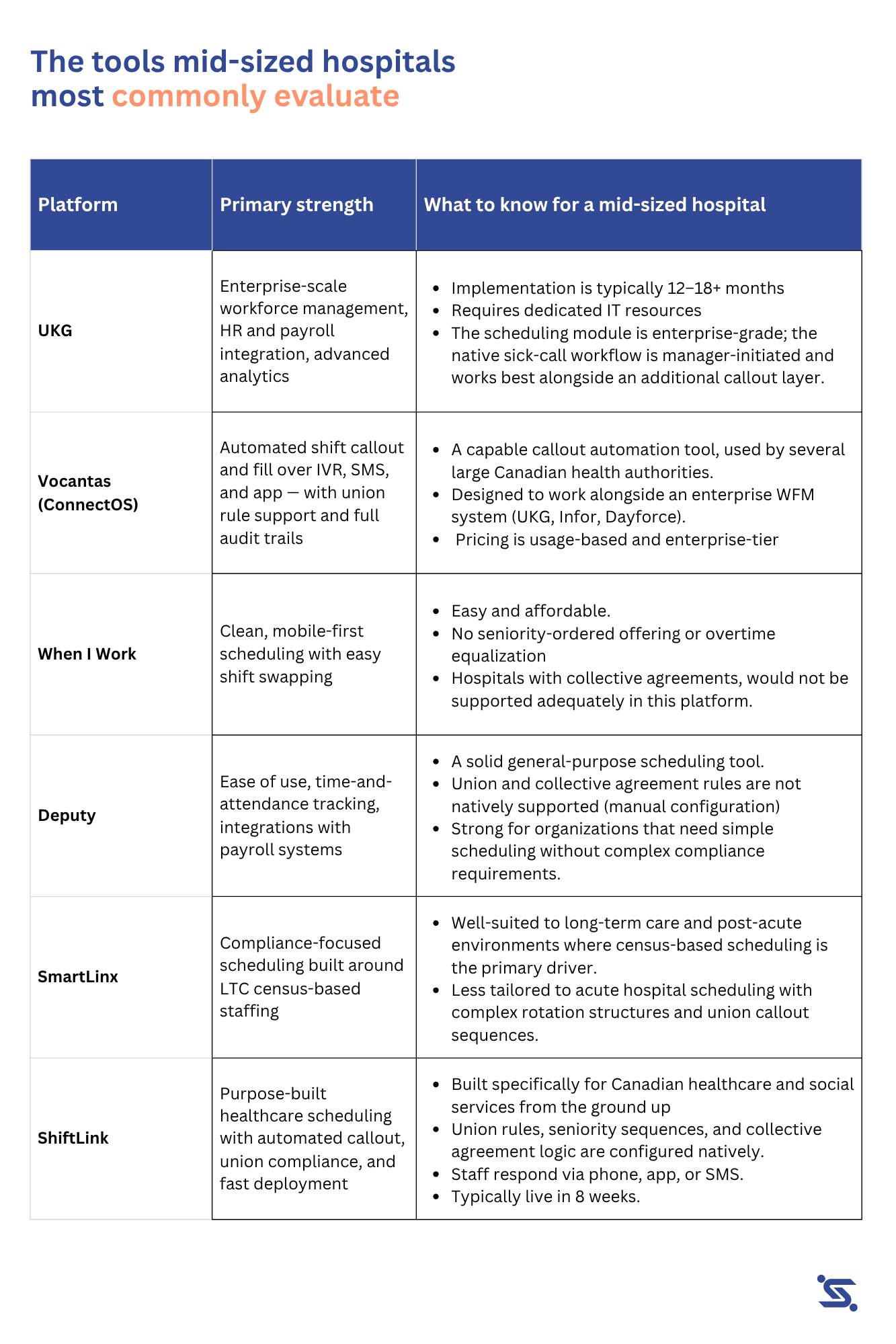
The platforms that appear most frequently in mid-sized hospital scheduling evaluations fall into distinct categories. Understanding what each was built for — and what it was not — saves significant time during the evaluation process.
Part 4: 5 questions to ask every vendor
Demo calls are optimized to show software at its best. These questions are designed to surface the gaps that demos do not show.
1. How does your platform handle seniority-based callout sequencing — and is that logic native, or does it require custom configuration?
The answer you want: native, configured at setup, not requiring ongoing manual maintenance. The answer to be cautious about: "we can configure that for you" or "our professional services team handles that." Custom configuration is implementation risk and ongoing maintenance burden.
2. What does your implementation timeline look like for an organization our size, and who owns the work on your side?
Ask for a named implementation lead, a week-by-week timeline, and a reference from a hospital of similar size that went live within the stated timeline. Vendors who cannot provide a reference from a comparable healthcare implementation have not done it before.
3. How do staff receive and respond to open shift notifications — and what happens if a staff member does not have a smartphone?
This question matters more in healthcare than in almost any other sector. Frontline healthcare workers — PSWs, dietary staff, housekeeping — often do not have smartphones or are not able to check apps during a shift. A scheduling platform that only works on mobile will leave a portion of your workforce unable to respond to callouts.
4. What does your audit trail look like, and can it be produced in a union grievance hearing?
Ask to see an actual audit log from a current customer — with identifying information removed. It should show, for each shift, who was contacted, in what order, at what time, and what the outcome of each contact was. If the vendor cannot show you this, your grievance exposure does not decrease when you implement their software.
5. What integrations do you have with our specific systems — and are those integrations native or API-based?
Name your exact systems: Meditech version, payroll system, HRIS. Native integrations are maintained by the vendor and update when either system updates. API integrations require monitoring and may break when either system is updated. Know which category your required integrations fall into before you sign.
Making the decision
Scheduling software for a mid-sized hospital is not an IT purchase. It is a workforce strategy decision with financial, clinical, and labour relations implications that touch every corner of the organization.
The hospitals that make this decision well do three things consistently:
- They build the business case before the evaluation — so the buying committee has a shared understanding of what success looks like before any vendor walks in the door.
- They include the right stakeholders from the beginning — so the decision reflects the needs of the people who will live with it, not just the people who approved it.
- And they ask the questions that demos are designed not to answer — about union compliance, implementation realities, and what happens when something goes wrong.
ShiftLink was built for this decision — and for what comes after it. If you are at the stage of evaluating options for your hospital, we are happy to walk through your specific collective agreement requirements, your current scheduling metrics, and what implementation would look like for your team.
Book a demo here
ShiftLink is purpose-built for Canadian hospitals, long-term care facilities, and social services organizations. Built in Ontario. Deployed across Canada.
Sources: Canadian Institute for Health Information, Nursing in Canada, 2023; NSI National Health Care Retention and RN Staffing Report, 2025; Canadian Federation of Nurses Unions, 2025.