


If you manage workforce scheduling at a mid-sized Canadian hospital, you occupy an uncomfortable middle ground in the software market.
You are too large for the simple, affordable tools built for clinics and small care homes. You are not large enough — or not IT-resourced enough — to absorb an 18-month enterprise implementation that requires a dedicated configuration project before a single shift gets filled differently.
And you have something that most scheduling software was not designed for: a collective agreement. Seniority rules. Callout sequences that need to be followed in a specific order. Grievance documentation that must exist before anyone asks for it. Multi-department coverage requirements that change by unit, by time of day, and by day of week.
Most buying guides do not distinguish between your situation and a restaurant chain's. This one does.
This guide is written for healthcare workforce managers, HR directors, and executive leaders at hospitals with 500 to 1,000 scheduled staff who are evaluating scheduling software — or who are starting to suspect their current process is costing more than they have calculated.
Part 1: The KPIs that actually matter for a hospital your size
Before you evaluate a single vendor, get clear on what you are trying to move. The most common mistake in software evaluation is leading with features rather than outcomes. Features are easy to demonstrate. Outcomes are what you will be accountable for twelve months after go-live.
Here are the metrics that matter — organized by the audience that owns each one.
Operational KPIs (owned by scheduling managers and department heads)
Shift fill rate — straight-time vs. overtime vs. agency
This is the single most important operational metric in hospital scheduling. You want to know, for every shift filled, whether it was filled by a straight-time employee, an overtime-eligible employee, or an external agency worker. Most hospitals track total fill rate. Fewer track the composition of that fill rate. The composition is where the cost lives.
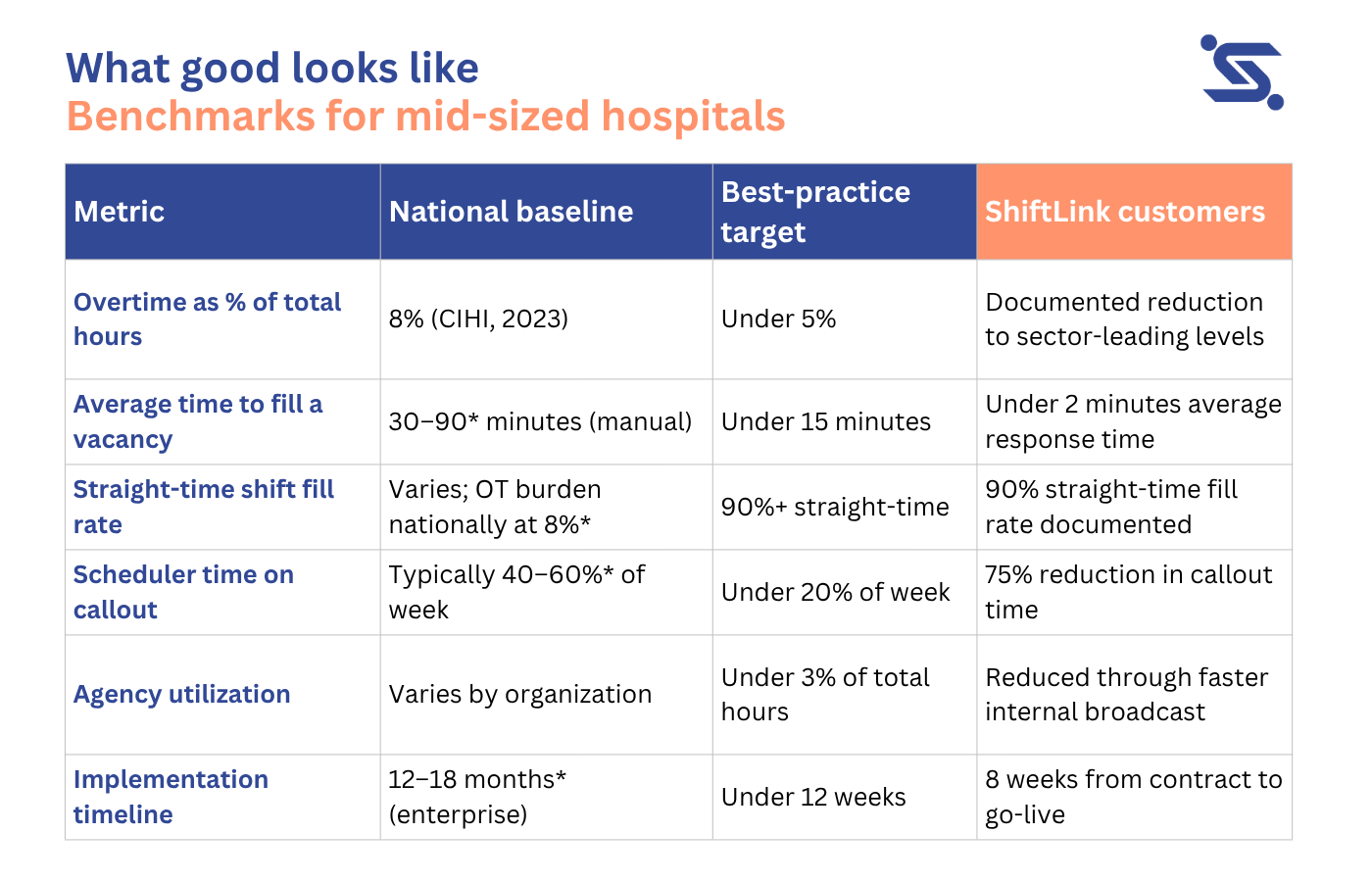
Target: 90%+ of shifts filled at straight-time. The national baseline, per CIHI, is burdened by an 8% overtime rate — meaning roughly one in twelve hours is worked at a premium. There is significant room between baseline and best practice.
Average time to fill a vacancy
How long does it take from the moment a shift becomes vacant to the moment it is confirmed filled? In a manual phone-down-a-list process, this is typically 30 to 90* minutes per vacancy. In an automated broadcast system, the average response time drops to under two minutes.
Time to fill matters beyond scheduling efficiency. Vacancies that take hours to fill increase the likelihood of mandatory overtime for staff already on shift — the most expensive and most resented form of overtime in healthcare.
Scheduler hours spent on callout per week
This number is almost always higher than managers estimate. Ask your schedulers to track it for two weeks before you begin a software evaluation. The number you get will be one of the strongest elements of your business case.
ShiftLink customers report reclaiming up to 75% of the time previously spent on manual callout processes. For a scheduler spending 20 hours a week on phone callouts, that is 15 hours returned to workforce planning, staff support, and proactive schedule management.
Agency utilization rate as a percentage of total hours
Agency fills represent the most expensive category of shift coverage. They occur when internal staff are not reached quickly enough — not because they were unavailable, but because the process was too slow to find them before the vacancy became urgent. Tracking agency utilization as a percentage of total hours, rather than as an absolute dollar figure, makes it easier to benchmark and to attribute changes to process improvements.
Financial KPIs (owned by CFO and finance team)
Overtime as a percentage of total hours worked
National average: 8% (CIHI, 2023). Target for a well-run scheduling operation: under 5%. The gap between those two numbers, multiplied by the overtime premium rate and your total annual hours, is the financial opportunity available to you through process improvement alone.
Cost per filled shift
Total scheduling cost — scheduler labor, overtime premiums, agency fees — divided by total shifts filled. This metric allows you to compare the true cost of your current process against the projected cost of an automated alternative, and to track improvement over time.
Year-over-year overtime spend trend
Is your overtime bill growing, flat, or declining? If it is growing — and in most Canadian hospitals it is — that trend line is the most compelling element of any business case for scheduling software investment.
Agency spend per month vs. internal cost per shift
The premium between agency cost and internal cost varies, but is typically significant. Every shift moved from agency coverage to internal straight-time coverage represents that premium captured back. Quantify this before your evaluation — it will anchor your ROI conversation with your CFO.
People KPIs (owned by HR and nurse leaders)
Staff satisfaction with scheduling fairness
This is harder to measure than the financial metrics, but it is one of the strongest leading indicators of retention. In unionized environments, perceived unfairness in scheduling — whether or not it constitutes a formal violation — drives grievances, disengagement, and voluntary departures. A simple quarterly pulse survey asking staff to rate scheduling fairness gives you a baseline and a trend.
Grievance volume related to scheduling
Track this separately from your total grievance count. Scheduling-related grievances — shift award disputes, seniority violations, callout sequence complaints — are the category most directly addressable through software. If this number is increasing, it is a signal that your current process is producing defensibility problems that documentation alone cannot solve.
Voluntary overtime uptake vs. mandatory overtime rate
There is a meaningful difference between a nurse who chooses an overtime shift because they want the hours and a nurse who is mandated to stay because no one was reached in time. Voluntary overtime, within appropriate limits, is a sign of a functional scheduling relationship. Mandatory overtime is a sign of a broken process and a driver of burnout and attrition.
Absenteeism and sick-leave rate
Canadian nurses took an average of 19 days of illness or disability leave in 2022 — more than double the rate of government and private sector employees. Scheduling-driven burnout is a contributor to this number. It is not the only one, but it is an addressable one, and it belongs in your scheduling software business case.
Compliance KPIs (owned by HR and labour relations)
Audit trail completeness for shift awards
Can you reconstruct, for any shift awarded in the past 12 months, exactly who was contacted, in what order, at what time, and why the shift was ultimately awarded to the person who received it? If the answer involves spreadsheets, email chains, or memory — your audit trail has gaps that a grievance hearing will find.
Collective agreement adherence rate
How frequently are scheduling decisions made that deviate from the rules in your collective agreement — intentionally or otherwise? In a manual process, deviations happen under time pressure and are rarely tracked. In an automated process, deviations are flagged before they occur.
Response time documentation
In some collective agreements, the sequence and timing of callouts is contractually specified. Documentation of when each staff member was contacted, and when they responded, is not optional — it is required for grievance defence. Your scheduling software should produce this documentation automatically, not require manual reconstruction.
Part 2: Who should be in the Rroom
The most common failure mode in healthcare scheduling software evaluation is a narrow buying committee. When IT leads the evaluation, the decision optimizes for integration and implementation risk. When a single scheduling manager leads it, the decision optimizes for their unit's workflow at the expense of organization-wide requirements. When finance leads it, the decision optimizes for cost at the expense of adoption and compliance.
The right buying committee for a mid-sized hospital scheduling software decision includes the following stakeholders — each with a defined role in the evaluation:
Chief Nursing Officer or Director of Care
Owns clinical coverage requirements and the staff experience of scheduling. The CNO is the voice of what adequate staffing looks like in practice — not in theory — and the advocate for the workforce whose daily experience will be most affected by the software chosen. Without CNO involvement, scheduling software decisions routinely underweight the frontline staff experience and overweight administrative efficiency.
HR Director and Labour Relations Lead
Owns collective agreement compliance and grievance risk. This is the stakeholder who can tell you, specifically, where your current scheduling process creates legal exposure — and what a defensible audit trail needs to contain. Labour relations involvement early in the evaluation process prevents costly surprises during configuration, when vendors discover that your collective agreement has requirements their platform was not built to handle.
CFO or VP Finance
Owns the business case: overtime reduction, agency cost savings, and the ROI timeline that determines whether this investment is approved. The CFO needs to see a calculation, not a slide deck. Build the business case before the evaluation, not after — it clarifies what you need the software to do and gives you a framework for comparing vendor commitments to your actual numbers.
Scheduling Managers and Administrative Supervisors
The day-to-day users. Their adoption determines whether the software actually works. Their input during evaluation surfaces the workflow requirements that no vendor demo will show you unless you ask. Include scheduling managers from multiple departments and shifts — the experience of a day-shift scheduling coordinator in a surgical unit and a night-shift coordinator in emergency are not the same, and your software needs to work for both.
IT and Systems Integration Lead
Owns integration with your existing systems — Meditech, payroll, HRIS — and the data migration that precedes go-live. IT involvement prevents the most common implementation failure: discovering, after contract signing, that the integration you assumed existed requires custom development. Ask every vendor, before shortlisting them, for a specific integration statement covering your exact system versions.
Union Representative (advisory capacity)
In unionized environments, early and transparent consultation with union leadership reduces resistance and accelerates adoption. Staff trust in a new scheduling system is significantly higher when their union representatives have been involved in the evaluation — even in a non-decision-making capacity. The alternative — announcing a new system to staff who hear about it through their union rep after the fact — creates adoption headwinds that no training program fully overcomes.
Watch out for Part 2 !!
Book a demo at shiftlinkapp.com
ShiftLink is purpose-built for hospitals, long-term care facilities, and social services organizations.
Built in Ontario. Deployed across Canada and USA.
Sources: Canadian Institute for Health Information, Nursing in Canada, 2023; NSI National Health Care Retention and RN Staffing Report, 2025; Canadian Federation of Nurses Unions, 2025.