

Canada’s hospitals are working harder to keep the doors open. The question is whether they are working smarter with the workforce they already have. There is a number in Canadian healthcare that deserves more attention.
32 million.
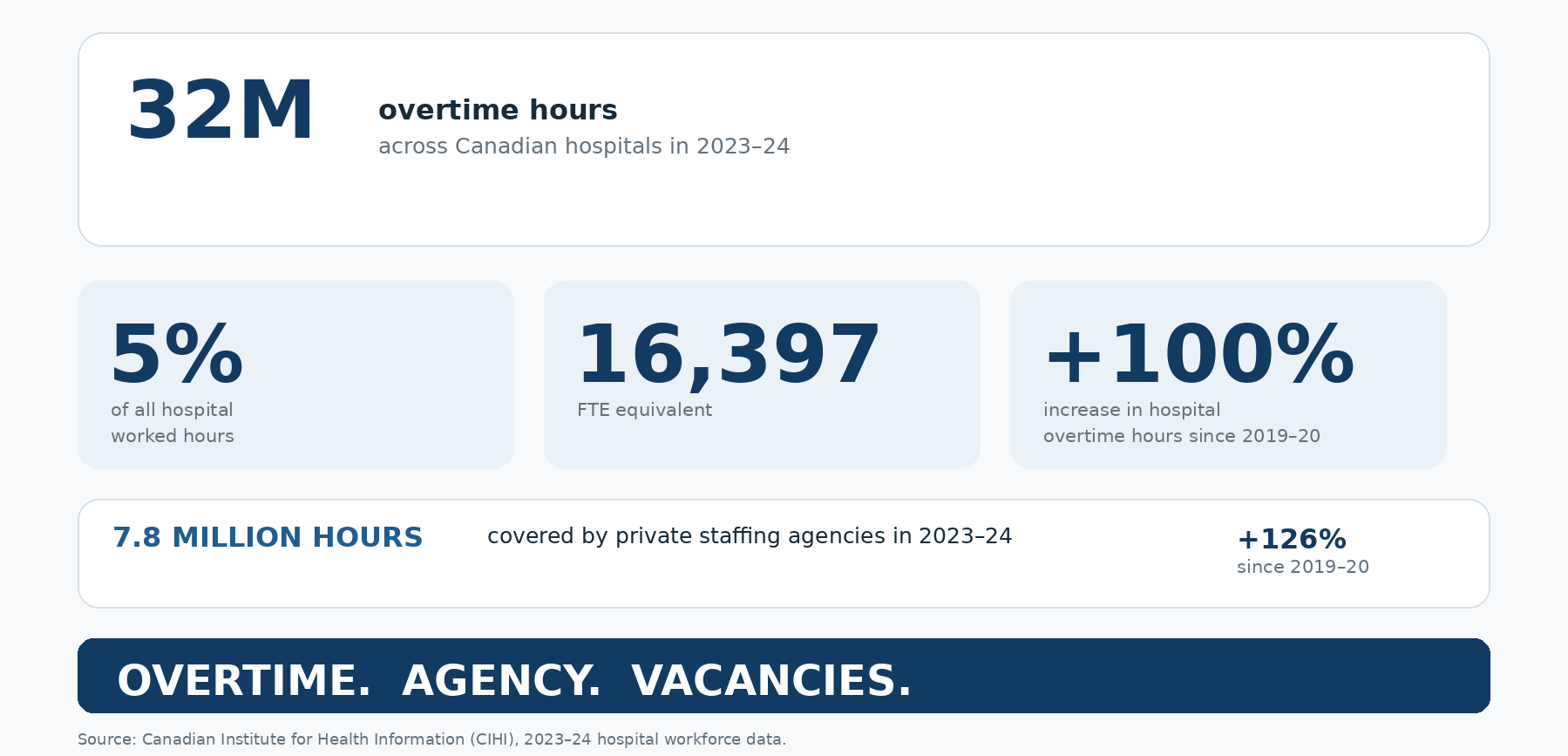
That is roughly how many overtime hours were worked across Canadian hospitals in 2023–24, according to the Canadian Institute for Health Information (CIHI).
Five percent of all hospital worked hours. The equivalent of about 16,397 full-time positions.
It is a big number. But the number itself isn't the most interesting part. The interesting part is what it might be telling us.
Because when overtime becomes this large, the conversation can't just be:
“We need more staff.”
Sometimes we do.
But overtime can also tell us something about how the workforce is being deployed, scheduled and managed.
And that is a different conversation.
32 million hours doesn't mean 32 million avoidable hours
Let's start with an important caveat. Some overtime is unavoidable.
Patients don't arrive according to a staffing grid. Emergencies don't check the schedule before happening. A sick call at 6:00 p.m. doesn't care that the unit is already short. Healthcare will always need some flexibility.
CIHI itself notes that overtime can help hospitals manage fluctuations in patient-care needs. But it also points to consistently high overtime as a possible sign of broader system challenges.
So this isn't an argument for zero overtime. It's a question of what happens when overtime stops being the exception and starts becoming part of the operating model.
They are often different responses to the same underlying problem:
How do we get the right people into the right place at the right time when demand changes faster than the workforce can?
Start with the shift that didn't get filled
Imagine a Tuesday night. A unit has an unexpected vacancy. Someone calls in sick. The shift needs to be covered.
The scheduler starts calling. One person isn't available. Another has already reached their hours. Someone else doesn't answer.
A few more calls. A voicemail. A callback. The clock moves. Eventually, someone picks it up. Maybe it's overtime.
Maybe it's agency. Maybe the shift is split. Maybe the manager stays late. From payroll's perspective, the result is simple:
Overtime.
But the overtime didn't begin when the employee clocked in. It began much earlier. With a vacancy. With a process.
With a series of decisions about who was available, who was eligible, who was contacted, how quickly they responded and what options were exhausted before overtime became the answer.
That is why looking only at the overtime number isn't enough.
You have to look upstream.
Ask the question!!
Was there genuinely nobody available?
OR
Did we fail to find the person who was?
The schedule may be part of the problem
There is another place worth looking: the master rotation.
If the same shifts repeatedly end up vacant, it is tempting to blame availability. But what if the pattern starts earlier?
A rotation may not line up well with demand. FTEs may not be distributed effectively.
Weekends may be concentrated in the wrong places. Rest and consecutive-shift rules may narrow the available pool.
A role may be technically staffed but operationally difficult to deploy. And suddenly a problem that looks like:
“We don't have enough people.” may actually be: “We don't have the right coverage in the right places at the right time.”
Those aren't the same problems.
There is a cost hiding behind the cost
CIHI's latest hospital expenditure data shows just how significant workforce costs are.
Employee compensation accounts for roughly two-thirds of hospital costs in Canada. In 2022–23, overtime compensation alone surpassed $1 billion, while spending on agency workers reached $1.4 billion.
That changes how we should think about scheduling. A schedule isn't just an HR document.
It is a financial document. Every decision about coverage affects where labour dollars go.
Straight-time hours. Overtime. Agency. Administrative time.
And sometimes, the cost of not being able to fill a shift at all.
And then there is the human cost
We shouldn't lose sight of the people behind the number. An extra hour here. Another shift there. A late finish.
A weekend picked up because nobody else was available. Eventually, “just one more shift” becomes normal.
CIHI has linked high workloads, longer work hours and limited flexibility with pressure on healthcare workers, while noting that workforce sustainability involves much more than simply increasing staff numbers.
There is a difference between asking your workforce to be flexible and building a system that depends on their flexibility.
The first can be necessary. The second isn't sustainable.
So what do we do with the 32 million hours?
Not eliminate them. Understand them.
Break them down. Find the patterns.
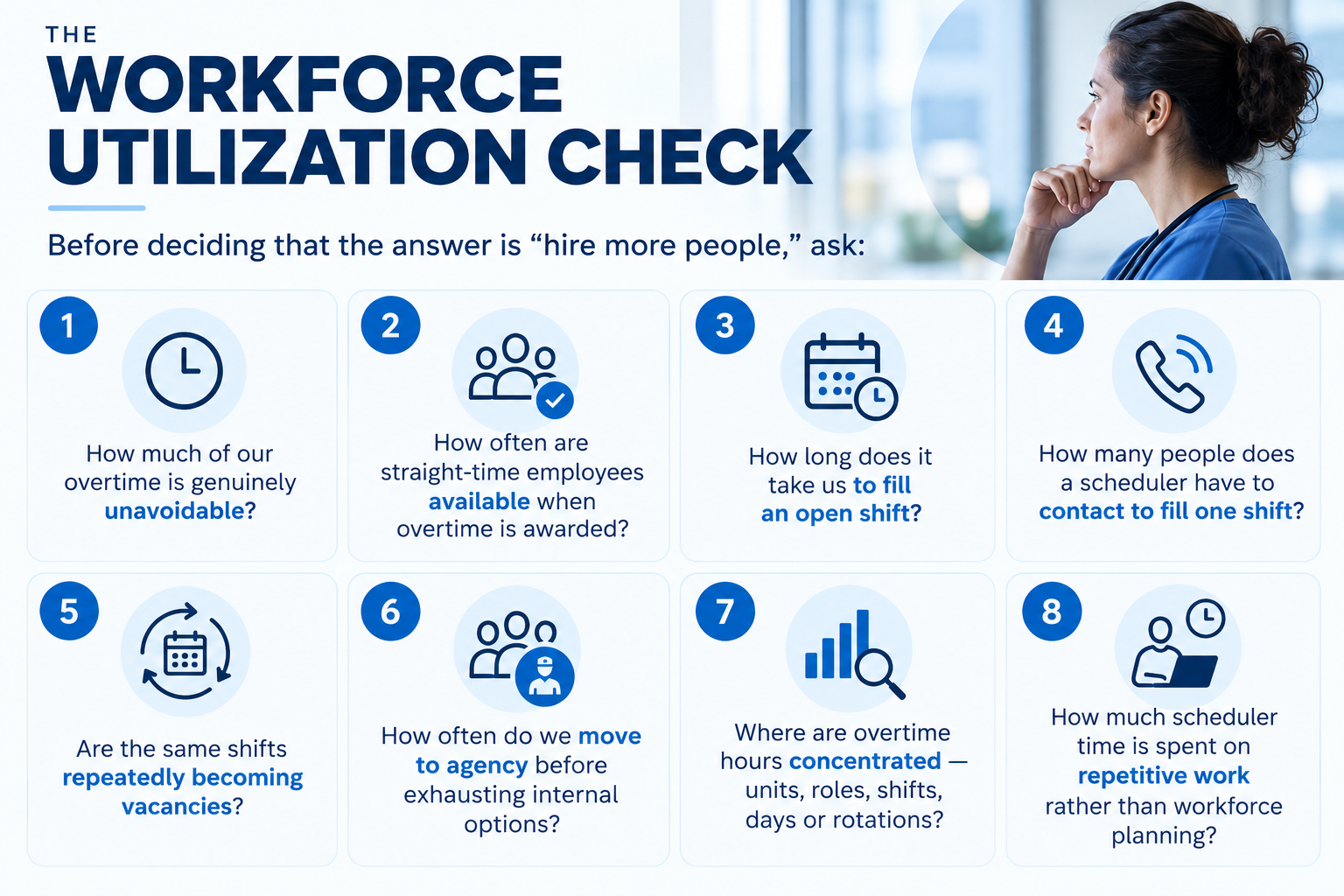
- Which overtime is unavoidable?
- Which is caused by genuine vacancies?
- Which comes from last-minute changes?
- Which comes from recurring gaps in rotations?
- Which happens because internal staff weren't reached quickly enough?
- Which happens because the scheduling process itself is too slow?
- And which could potentially have been filled at straight time?
That's where better workforce management starts. Not with another dashboard. Not with another spreadsheet.
And not with the assumption that every uncovered shift means another person needs to be hired.
It starts with being able to see why the shift became a problem in the first place.
The opportunity isn't to make healthcare workers work harder. They already are. The opportunity is to make the system around them work better. Better rotation design. Faster, fairer shift filling. Clear rules around eligibility and seniority. Better visibility into workforce availability.
Less time spent chasing people by phone. Better understanding of where overtime and agency are coming from. And better use of the workforce already on the payroll. That's the thinking behind ShiftLink. Not pretending technology can solve a national healthcare staffing shortage.
It can't.
But if hospitals are going to ask their existing workforce to carry the system through another difficult shift, they should at least make it easier for that workforce to be deployed well.
Because 32 million overtime hours aren't just a payroll number.
They're a signal. The question is whether we're listening.
Source note
The 32-million-hour figure comes from CIHI's 2023–24 hospital staffing data. It represents overtime across hospital staff and is not the same measure as CIHI's separate frontline-provider/nursing-unit overtime indicator. CIHI notes that the national hospital staffing data excludes Quebec and Nunavut and, for some 2023–24 measures, Saskatchewan; methodology and coverage vary by indicator.