

There is a number that should be on the desk of every hospital leader in Canada.
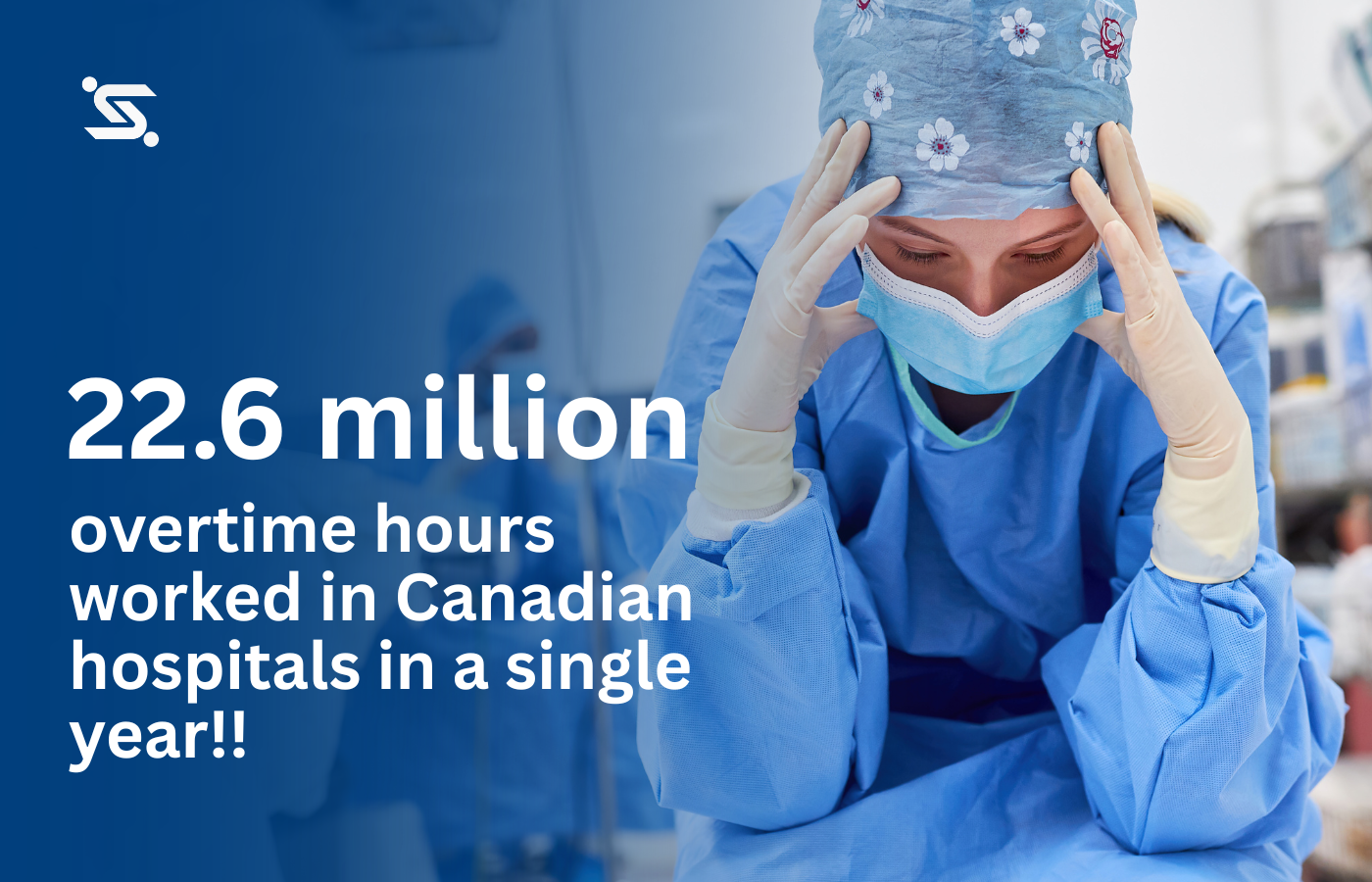
22.6 million.
That is the number of overtime hours worked by patient care providers in Canadian hospitals in 2023. It represents 8% of all hours worked in hospital nursing — one in every twelve hours, paid at a premium rate, carrying downstream consequences that extend well beyond the pay period in which they appear.
(Source: Canadian Institute for Healt h Information, Nursing in Canada, 2023)
The instinct, when confronted with a number like this, is to reach for the staffing lens. Not enough nurses. Not enough bodies. A workforce crisis that requires more recruitment, more training, more pipeline.
That instinct is understandable. It is also incomplete.
Because a significant portion of those 22.6 million hours were not clinically necessary. They were not generated by patient acuity or genuine staffing shortages. They were generated by the process used to fill open shifts — a process that, in many Canadian hospitals, has not meaningfully changed in decades.
This is a process problem. And process problems are fixable.
How overtime actually accumulates
Walk through what happens when a shift goes vacant in a typical mid-sized Canadian hospital.
A scheduler opens a list. They call the first name on it. No answer — voicemail. They call the second. Busy. The third picks up, says yes, and the shift is filled.
It took 45 minutes. The person who said yes has already worked 36 hours this week. They are now into overtime territory. But they were the third call, they were available, and the shift needed to be filled.
This scenario plays out dozens of times a week in hospitals across the country. And it contains the structural flaw responsible for a large share of avoidable overtime:
The process selects for availability, not eligibility.
There is no filter, in a manual callout process, that deprioritizes staff who are approaching overtime thresholds. There is no mechanism that surfaces a part-time staff member who wants more hours before it reaches a full-time employee who is already at capacity. There is no visibility, at the moment of the decision, into what this shift will cost compared to what it could cost if a different person were called first.
The result is that overtime is not distributed by necessity. It is distributed by proximity to the phone.
What overtime is actually costing
Most hospital finance teams track overtime as a line item. Fewer track the full cost of what overtime does to the workforce that produces it.
The direct cost is straightforward: premium pay on hours that, in many cases, could have gone to straight-time workers who were never reached before the shift was filled.
The burnout cost is less visible but more damaging. Nine in ten Canadian nurses report some degree of burnout, according to a 2025 Canadian Federation of Nurses Unions survey. Nearly half report working overtime regularly — and research has consistently linked overtime exposure to elevated burnout risk.
A four-year longitudinal study found that overtime workers face more than three times the odds of high burnout levels compared to colleagues without overtime, with risk compounding over time rather than stabilizing.
Burnout is not an abstract wellness concern. It is a precursor to the outcomes every hospital leader is trying to prevent: medication errors, near-misses, and the decision to leave the profession entirely.
The patient safety cost is the one that gets the least attention in scheduling conversations. A 2024 study published in JAMA Network Open found a direct association between nurse burnout and patient safety performance. When the same nurses are regularly pushed into overtime because the scheduling process fails to distribute hours equitably, the clinical risk is not theoretical.
The turnover cost is where the math becomes stark. Replacing one registered nurse costs an average of $61,110 USD — an 8.6% increase from the prior year, according to the 2025 NSI National Health Care Retention and RN Staffing Report.
Canadian hospitals typically lose between $3.9 million and $5.7 million annually to nurse turnover. And when nurses are asked, scheduling-related reasons appear consistently among their stated drivers for leaving: lack of schedule control, perceived unfairness in shift distribution, and the grinding accumulation of involuntary overtime.
Over one third of Canadian nurses reported working involuntary overtime in the previous six months, per the 2025 CFNU survey. Involuntary overtime is not just expensive. It is a signal to staff that their time is not valued — and staff act on that signal.
What fixing the process looks like
The intervention is not complicated in principle, even if implementation requires care.
Replace sequential calling with simultaneous broadcast. Rather than working down a list one by one, scheduling software broadcasts an open shift to all eligible staff simultaneously. Every qualified person gets the same notification at the same moment. The first to respond who meets the applicable rules gets the shift. This single change — moving from sequential to simultaneous — is the most direct lever available for reducing the overtime accumulation that comes from manual callout processes.
Apply rules at the moment of the offer, not after. In a manual process, rules — seniority, hours worked, overtime thresholds — are checked after the fact, if at all. ShiftLink applies them before a shift is awarded. Staff who are close to overtime thresholds are deprioritized automatically. Staff who have fewer hours and are eligible under the collective agreement are surfaced first. The rule is applied consistently, every time, without requiring a scheduler to remember it under time pressure.
Make cost visible before the decision is made. A scheduler who can see, in real time, that offering this shift to this person will push them into overtime — and that there is a straight-time-eligible alternative available — will make a different decision. The information needs to be present at the moment of the decision, not in a report that arrives the following week.
Document everything. In unionized environments, the defensibility of a scheduling decision matters as much as the decision itself. Every shift offer, response, and award should be time-stamped and searchable. When a grievance is filed — and in complex healthcare scheduling environments, they will be — the documentation should be there, ready, without anyone having to reconstruct it from memory.
What this looks like in practice
ShiftLink customers have applied this approach and documented the outcomes directly.
One 500-staff hospital team reduced overtime spending by more than $1 million over an eight-month period following implementation of automated shift callouts. The change was not a reduction in patient care hours or a staffing reduction. It was a change in how available shifts were offered — simultaneous broadcast, rules-based awarding, real-time cost visibility.
Concordia Hospital filled over 1,900 vacant shifts through ShiftLink's automated callout system — reducing both the administrative burden on schedulers and the reliance on overtime and agency staff to fill gaps that the internal roster could have covered if reached efficiently.
Across active ShiftLink hospital deployments, the average shift fill rate on a straight-time basis is 90%. The national average, per CIHI, is burdened by an 8% overtime rate. The gap between those two numbers is the size of the opportunity.
The question every hospital leader should be asking
Do you know what percentage of your overtime hours last month were avoidable?
Most hospital leaders do not — because their current tools do not surface that number. Overtime appears as a total. It does not appear broken down by whether it was clinically necessary, generated by a genuine shortage, or produced by a scheduling process that called the wrong person in the wrong order.
That distinction matters enormously — both for the budget case and for the workforce one. Avoidable overtime is not a fixed cost. It is a choice embedded in a process. And the process can be changed.
The 22.6 million hours is not a ceiling. It is a baseline. And for Canadian hospitals willing to look at the scheduling process behind it, it is one of the most accessible cost and retention levers available.
What this is not
Improving the scheduling process is not a replacement for adequate staffing. Canada does face genuine workforce shortages in nursing and allied health, and those require their own policy and pipeline responses.
But solving the staffing shortage does not fix the scheduling problem. Hospitals can hire more nurses and still distribute their hours inefficiently — generating avoidable overtime, burning out the staff they have, and accelerating the turnover that drives the shortage they are trying to solve.
The scheduling process and the staffing pipeline are separate levers. Both need to be pulled. This blog is about the one that is within reach right now, with the staff already on your roster.
Where to start?
If you want to understand the scale of avoidable overtime at your organization, start with two questions:
- What percentage of your overtime hours last month went to staff who were already at or near their contracted hours when the shift was offered?
- How many staff members who had available hours and were eligible for those shifts were never reached before the shift was filled?
If you cannot answer those questions with current data — your scheduling process is producing overtime you cannot see, measure, or prevent.
ShiftLink gives hospital scheduling teams the visibility and automation to answer both questions — and act on the answers.
Book a demo with us to see how ShiftLink handles your collective agreement rules, shift callout workflows, and overtime tracking in a live session with your team.
ShiftLink is purpose-built for Canadian hospitals, long-term care facilities, and social services organizations. Built in Ontario. Deployed across Canada.
Sources: Canadian Institute for Health Information, Nursing in Canada, 2023; Canadian Federation of Nurses Unions, 2025; NSI National Health Care Retention and RN Staffing Report, 2025; JAMA Network Open, 2024.